

Soft-Centered Gingersnaps
Gingersnaps don’t have to be hard and brittle. This recipe produces cookies with soft centers and crisp exteriors. Molasses is a hygroscopic sweetener, meaning it absorbs moisture, so the cookies may soften as they sit, especially in humid weather.
To help the cookies retain their rounded shape rather than flattening during baking, it is important not to cream the butter and sugar. The more air you work into the butter and sugar, the more the cookies will spread. Mixing them only until combined produces a dough that holds its shape.
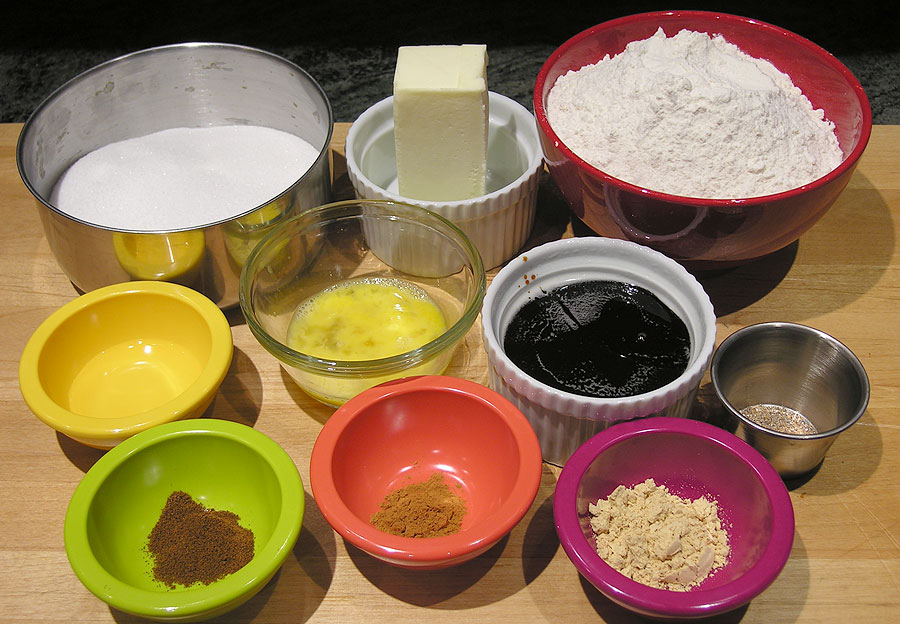
Making the Gingersnaps
The complete recipe and detailed instructions are at the end of this post. For this recipe, we need butter, sugar, egg, molasses, vinegar, flour, baking soda, ginger, cinnamon, cloves, cardamom and Turbinado sugar. Looks like we have it all. Ready, set, bake…
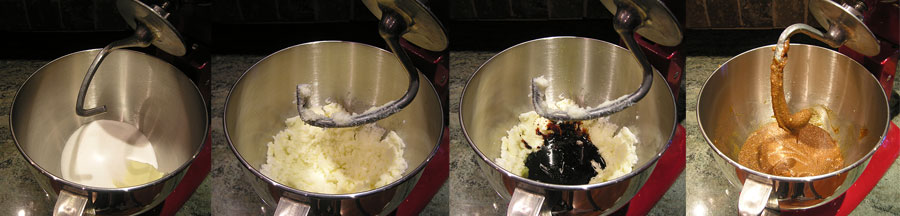
Using the dough hook at low speed, mix the butter and sugar together until just combined. Add the egg, molasses and vinegar and mix until combined.

Sift together the flour, baking soda, ginger, cinnamon, cloves and cardamom. Add the dry ingredients to the butter mixture and mix on low speed until just combined. Cover and refrigerate until firm, about 30 minutes.

Divide the dough into 2 equal pieces, approximately 1 pound 2 ounces (510 g) each. Roll each piece into an 18-inch (46 cm) rope and cut each rope into 30 equally sized pieces. I used a ruler, but you could cut the rope into sections and continue dividing until you have 30 roughly equal pieces.
Form the pieces into round balls and press the tops into Turbinado sugar. My cookies were perfect balls until I dipped them in sugar. To get the sugar to stick, I had to press fairly hard. For more perfectly rounded cookies, lightly brush the balls with water and sprinkle them with sugar instead. I like the odd shapes produced in the process. Place the cookies sugar-side up on sheet pans lined with parchment paper.
Bake at 375°F (191°C) until lightly browned on top but still soft in the center, approximately 12 minutes. Baking time will vary depending on your oven and the size of the cookies. Humid weather may also cause the cookies to take slightly longer to bake.
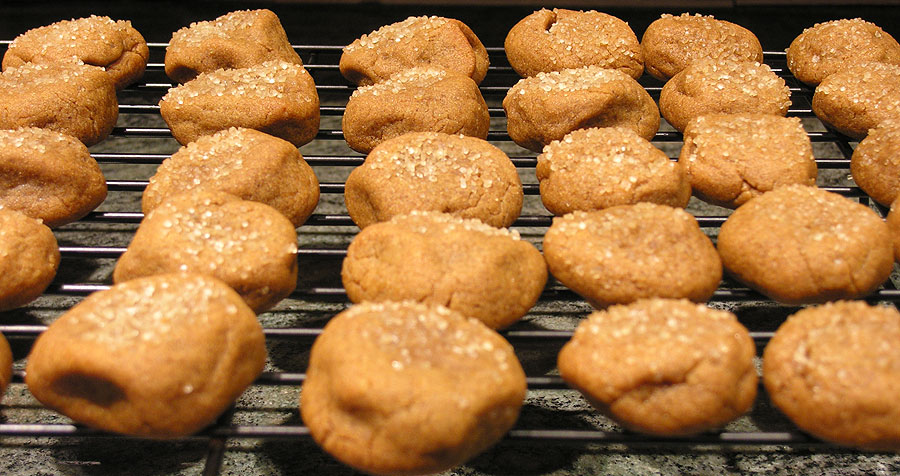
Gingersnaps
Warmly spiced molasses cookies with crisp sugar-coated exteriors and soft centers.
Adapted from The Professional Pastry Chef: Fundamentals of Baking and Pastry, 4th Edition.
Ingredients
- 4 ounces (113 g) unsalted butter, at room temperature
- 11 ounces (313 g) granulated sugar
- ½ large egg, beaten, approximately 25 g
- ½ cup (120 ml) or 6 ounces (170 g) molasses
- 1 tablespoon (15 ml) distilled white vinegar
- 14 ounces (398 g) bread flour
- 1 tablespoon (12 g) baking soda
- 2 teaspoons (4 g) ground ginger
- ½ teaspoon (0.75 g) ground cinnamon
- ½ teaspoon (1 g) ground cloves
- ½ teaspoon (1 g) ground cardamom
- Turbinado sugar, as needed for coating
Instructions
- Using the dough hook at low speed, mix the butter and granulated sugar until just combined. Do not cream the mixture.
- Add the beaten egg, molasses and vinegar. Mix only until evenly combined.
- Sift together the bread flour, baking soda, ginger, cinnamon, cloves and cardamom.
- Add the dry ingredients to the butter mixture and mix on low speed until just combined. Cover and refrigerate the dough until firm, about 30 minutes.
- Preheat the oven to 375°F (191°C). Line sheet pans with parchment paper.
- Divide the dough into 2 equal pieces, approximately 1 pound 2 ounces (510 g) each.
- Roll each piece into an 18-inch (46 cm) rope and cut each rope into 30 equally sized pieces.
- Shape each piece into a ball. Press the top of each ball into Turbinado sugar, or lightly brush the top with water and sprinkle it with sugar.
- Place the cookies sugar-side up on the prepared sheet pans, leaving enough space between them for slight spreading.
- Bake until the tops are lightly browned but the centers remain soft, approximately 12 minutes.
- Allow the cookies to cool briefly on the pans before transferring them to wire racks.
Recipe Notes
- Do not cream the butter and sugar. Mixing only until combined limits the amount of air incorporated into the dough and helps the cookies retain their rounded shape.
- To measure half an egg accurately, beat one large egg until uniform and weigh approximately 25 g for the recipe.
- The original rope measurement listed 18 inches as 35 cm. The correct conversion is approximately 46 cm.
- Molasses absorbs moisture from the surrounding air, so the cookies may become softer when left uncovered, particularly in humid conditions.
- For softer centers, remove the cookies while they still look slightly underdone in the middle. They will continue to set as they cool.
- For crisper cookies, bake them a minute or two longer and allow them to cool completely uncovered before storing.
- Store cooled cookies in an airtight container at room temperature. Adding a piece of bread to the container will make them softer, while storing them without bread will help preserve a firmer texture.
- The dough may be refrigerated for up to 2 days before shaping. Let it soften slightly at room temperature if it becomes too firm to portion.
- Unbaked dough balls may be frozen on a sheet pan and then transferred to a freezer-safe container. Bake from frozen, adding a few minutes as needed.
Gingersnaps FAQs
Why are these gingersnaps soft instead of hard?
The cookies are removed from the oven while their centers are still soft. Molasses also attracts and retains moisture, helping the cookies remain tender as they cool.
Why shouldn’t I cream the butter and sugar?
Creaming incorporates air into the dough and encourages the cookies to spread. Mixing only until combined helps them retain a thicker, more rounded shape.
How do I measure half an egg?
Beat one large egg until the yolk and white are completely combined, then weigh approximately 25 g. Save the remaining egg for another recipe.
Can I use all-purpose flour instead of bread flour?
Yes. All-purpose flour will work, although the cookies may be slightly more tender and may spread a little more because it contains less protein than bread flour.
Can I leave out the cardamom?
Yes. The cardamom adds a warm, aromatic flavor, but the cookies will still taste like traditional gingersnaps without it.
Why did my cookies spread too much?
The butter may have been too warm, the butter and sugar may have been mixed too vigorously or the dough may not have chilled long enough. Chill the dough until it is firm before shaping and baking.
Why didn’t the sugar stick to the dough?
Lightly brush the tops of the dough balls with water before dipping or sprinkling them with Turbinado sugar. Only a small amount of water is needed.
How can I make the cookies crisper?
Bake the cookies for an additional minute or two, until the centers are more firmly set. Let them cool completely uncovered before placing them in an airtight container.
How should I store gingersnaps?
Store completely cooled cookies in an airtight container at room temperature. They are generally best within about one week.
Can I freeze the baked cookies?
Yes. Freeze the cooled cookies in an airtight container with parchment between the layers. Thaw them at room temperature before serving.
Can I prepare the dough ahead of time?
Yes. Cover and refrigerate the dough for up to 2 days. Allow it to soften slightly at room temperature if it is too firm to divide and shape.
What kind of molasses should I use?
Regular or dark unsulphured molasses works well. Blackstrap molasses is much more bitter and may overpower the spices, so it is not the best choice for this recipe.
What equipment do I need for this recipe?
Recommended equipment: Dough hook (opens Amazon in a new tab), Kitchen scale (opens Amazon in a new tab), Baking sheet (opens Amazon in a new tab), Parchment paper (opens Amazon in a new tab), Cooling racks (opens Amazon in a new tab), Fine-mesh sieve (opens Amazon in a new tab).
As an Amazon Associate, I earn from qualifying purchases.
What is the estimated nutrition per cookie?
Estimated nutrition per cookie: Calories: 67 calories; Carbohydrates: 12.4 g; Protein: 0.8 g; Fat: 1.6 g; Saturated Fat: 1 g; Unsaturated Fat: 0.6 g; Trans Fat: 0.1 g; Cholesterol: 6 mg; Sodium: 2 mg; Fiber: 0.2 g; Sugar: 7.4 g.


 Jeff’s Baking Blog